
Not Found
Digital Seminar

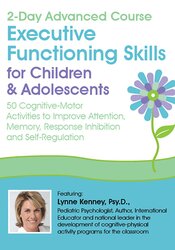
2-Day Advanced Course: Executive Functioning Skills for Children & Adolescents: 50 Cognitive-Motor Activities to Improve Attention, Memory, Response Inhibition and Self-Regulation


Speaker:
Lynne Kenney, PsyD
Duration:
12 Hours 19 Minutes
Language:
Presented in EN, subtitles in EN and FR, handouts in EN and FR
Copyright:
Feb 08, 2024
Product Code:
POS055535
Media Type:
Digital Seminar


Description

In this course, Lynne Kenney, Psy,D., pediatric psychologist, author and international educator, will show you how to integrate the newest research in neuroscience, kinesiology and neurocognitive education for students to behave better and learn more efficiently.

You will experience 50 developmentally progressive cognitive-exercises and coaching activities to enliven your classroom, office and clinic.  Learn how to improve cognition, enhance learning and empower children to be better thinkers with motor movement, sequencing, attending, selfregulation and memory activities.

Dress comfortably, as we will be integrating movement throughout the training.

Credit

Program Information

Planning Committee Disclosure - No relevant relationships

All members of the PESI, Inc. planning committee have provided disclosures of financial relationships with ineligible organizations and any relevant non-financial relationships prior to planning content for this activity. None of the committee members had relevant financial relationships with ineligible companies or other potentially biasing relationships to disclose to learners.  For speaker disclosures, please see the faculty biography.


Canada Credit - *

NOTE: Tuition includes one free CE Certificate (participant will be able to print the certificate of completion after passing the online post-test (80% passing score) and completing the evaluation). Instructional methods will include PowerPoint, didactic lecture, and others.

Continuing Education Information:  Listed below are the continuing education credit(s) currently available for this non-interactive self-study package. Program content is reviewed periodically per accrediting board rules for currency and appropriateness for credit. Credit approvals are subject to change. Please note, your licensing board dictates whether self-study is an acceptable form of continuing education, as well as which credit types are acceptable for continuing education hours. Please refer to your licensing board's rules and regulations. If your profession is not listed, please contact your licensing board to determine your continuing education requirements and check for reciprocal approval. 
For other credit inquiries not specified below, please contact info@pesi.com or 800-844-8260 before purchase.

Materials that are included in this course may include interventions and modalities that are beyond the authorized practice of your profession.  As a licensed professional, you are responsible for reviewing the scope of practice, including activities that are defined in law as beyond the boundaries of practice in accordance with and in compliance with your profession's standards.  

For Planning Committee disclosures, please see the statement above.  For speaker disclosures, please see the faculty biography.


Canada Credit - ---

Earn up to 12.25 CE hours. Please see below, for more details, as credit amounts vary by jurisdiction and profession. 


Canada Credit - Canadian Counsellors and Psychotherapists

PESI, Inc. is approved by the Canadian Counselling and Psychotherapy Association to offer continuing education for counsellors and psychotherapists. PESI, Inc. maintains responsibility for the program. This self-study activity is approved for 12.0 credit hours.


Canada Credit - Canadian Psychologists

PESI, Inc. is approved by the Canadian Psychological Association to offer continuing education for psychologists. PESI, Inc. maintains responsibility for the program. This program is approved for 12.0 self-study continuing education hours. Full credit statement at: www.pesi.com/cpa-statement


Canada Credit - Social Workers - National ASWB ACE

PESI, Inc., #1062, is approved as an ACE provider to offer social work continuing education by the Association of Social Work Boards (ASWB) Approved Continuing Education (ACE) program. Regulatory boards are the final authority on courses accepted for continuing education credit. ACE provider approval period: January 27, 2026 - January 27, 2029. Social workers completing this course receive 12.25 Clinical continuing education credits.

Course Level: Intermediate Format: Recorded asynchronous distance. Full attendance is required; no partial credits will be offered for partial attendance.


Canadian Social Workers: Canadian provinces may accept activities offered by providers approved by the ASWB ACE program for ongoing professional development.


Canada Credit - Other Professions

This self-study activity qualifies for 12.25 continuing education clock hours as required by many national and local licensing boards and professional organizations. Save your activity advertisement and certificate of completion, and contact your own board or organization for specific requirements.


US National Boards - Nurses, Nurse Practitioners, and Clinical Nurse Specialists – ANCC

PESI, Inc. is accredited as a provider of nursing continuing professional development by the American Nurses Credentialing Center’s Commission on Accreditation. Nurses completing these self-study materials will earn 12.25 contact hours. Expires: 10/20/2026.


Handouts

Additional Info

Program Information

Access for Self-Study (Non-Interactive)

Access never expires for this product.

For a more detailed outline that includes times or durations of time, if needed, please contact cepesi@pesi.com


Questions?

Visit our FAQ page at https://www.pesicanada.ca/faq or contact us at https://www.pesicanada.ca/contact-us.


Objectives

  1. Utilize research-based activities to improve thinking, self-regulation, learning and behavior.
  2. Identify the biological and motor precursors to learning including balance, postural control, and coordinated movement patterns.
  3. Examine the meaningful relationship between cognition and motor movement in learning and school achievement.
  4. Integrate developmentally appropriate, cognitively engaging movement sequences that enhance attention, memory, and self-control through progressive cognitive-motor activities.
  5. Choose coaching and movement activities to help children with ADHD, dyslexia, ODD, sensory processing challenges, dyspraxia, anxiety and behavioral issues.
  6. Choose cognitive conversations, brain-based lessons, and THINK Cards to build metacognition, self-awareness, and agency in learning.
  7. Determine the role of tempo, rhythm and timing in cognition.
  8. Choose rhythmic calming strategies for on-the-spot behavior management.
  9. Utilize self-regulation practices that combine proprioceptive “heavy work,” rhythmic entrainment, and co-regulation techniques to help children transition from stress responses to a calm, alert learning state.
  10. Examine the role that rhythmic “heavy” motor work has for dysregulated children.
  11. Analyze the biological precursors to better executive function, learning, and behavior.
  12. Identify cognitive-movement strategies to help children move out of the stress response into an alert state of calm.

Outline

Priming the Brain for Learning

  • Impact of brain stimulation, stress, ACE’s and trauma on learning
  • Create low-stress-high-connection learning environments
  • Biological precursors to learning
  • New preliteracy
  • Executive function precursors
  • 5 early predictors of academic success
  • Create a calm classroom culture with kindness, respect & trust
  • Importance of collaboration, agency and creativity in learning and behavior

Foundational Motor Competencies that Proceed Learning

  • Balance and weight shift
  • Postural control for better learning
  • Foundational movement patterns & sequences
  • Types of patterns and elements
  • How to build a movement sequence
  • Activities
    • Balance activity
    • Teaching weight shift
    • Head, shoulders, hips & knees
    • Can everybody count
    • Initial brain primer sequences for attention, memory and self-control

Musical Thinking

  • We are musical
  • Using The Love Notes Measures are magic!
  • “We Move on the Beat in Time Together”
  • Sequence is the secret
  • Activities
    • Musical thinking rhythm cards
    • Communicating need sets musically
    • Movin’ and Groovin’ movement mixes
    • Creating your own standing patterns

Thinking Interventions for Better Learning and Behavior

  • Executive functions CAN be learned
  • Build core executive functions for achievement
  • Cognitive skills building process

“I am the Best Coach for My Brain” - Lessons for Students

  • Teach children about their brains
  • Make executive functions transparent
  • “Cognitive Conversation”
  • Activities
    • 8 brain lessons for students
    • Cognitive conversation prompts
    • The THINK Cards SAM Call and response cards

The “Cognitive Conversation” about Attention

  • My Attention Engine
  • Attention is more than one thing
  • Attention cycle
  • Types of attention
  • Activities
    • Prompts and questions
    • Raise mindful awareness
    • My Attention Engine
    • Songs and chants
    • Interactive conversational practice

Seated Work For Better Attention

  • Alert Attention
  • 1-5 minute desk percussion activities
  • Stadium effect
  • Compositions & orchestras
  • Activities
    • Table top tap
    • Repeat the beat
    • CogniTap
    • Paradiddles

Cognitive Engagement - Music, Piano & Drumming

  • Role of music in learning
  • Build musical skills through auditory channels
  • Imagination in spatial drumming
  • Meludia Method
  • Taiko
  • Activities
    • In Time (Advanced Brain Technologies) Solfege

Developing Your Own Patterns and Sequences

  • Patterns
  • Sequences
  • Elements
  • Sound and movement mixes
  • Cueing
  • Activities
    • You’re a conductor
    • We’re an orchestra

Language, Dyslexia, Reading and Learning

  • What the research says about the precursors to reading
  • Different types of dyslexia
  • Role of speed of processing in reading
  • Temporality, timing and prosody in reading
  • Are rhymers really readers?
  • Activities
    • Narrative language in daily life
    • Visual story-telling – sequencing and patterning in pictures
    • Lullabies, folk songs and rhyming songs
    • Circle pattern rhyming activities

Visual-Motor Language: Spotlight

  • What is Spotlight and how was it developed?
  • Collaboratively reading the visual-motor language
  • Importance of cognitive cueing
  • Use spotlight in various settings
  • Activities
    • Initial instructions to the student(s)
    • Mirror and alternate
    • Planer, lateral and contralateral movements for learning
    • Create your own sequences
    • The one spotlight movement circle

Brain Primers (Mike Kuczala)

  • Developmentally progressive cognitive engagement
  • Increase cognitive-motor demands
  • Engage creativity and collaboration
  • Engage the reluctant learner
  • Advanced mix and match elements, patterns and sequences
  • Activities
    • Brain primers

The “Cognitive Conversation” about Memory

  • Working, short-term, long-term, visual working, verbal (auditory) working memory
  • Encode and retrieval
  • Art, music and movement improve science
  • Activities
    • File cabinet visual prompt
    • Retrieve math facts with Quick Rick
    • Encoding spelling with Slow Mo
    • Working memory enhancement strategies
    • Visual memory enhancement techniques

Improving Behavior with Cognitive-Motor Movement

The “Cognitive Conversation” about SelfControl (Response Inhibition) + Impulsivity

  • Achieve better classroom cohesion, socialization and behavior with responsive movement
  • Difference between self-regulation and self-control
  • Response inhibition and impulsivity
  • Types of impulsivity (motor, verbal, cognitive)
  • “Felt-Sense” of slowing down (self-control and selfregulation)
  • 5 quick effective responses to dysregulated kids
  • Between urge, action and behavior
  • Trauma, cognition, and dysinhibition
  • Block repetitive anxious thoughts
  • Activities
    • Think-Ups
    • Mary and Her Me Me Me’s!
    • Periwinkle and Pace

Self-Regulation: Heavy Work

  • Push, pull and hold
  • How does proprioceptive feedback calm the brain and body?
  • What does the counting or cueing sound like?
  • Activities
    • Successful transitions
    • Stationary holds with the Musical Thinking Rhythm cards
    • Large-motor heavy play
    • Hand play

Self-Regulation: Achieving an Alert State of Calm

  • Self-regulation: emotional, cognitive, sensory/motor
  • Self-regulation as energy management
  • Use entrainment to reciprocally regulate 3,5,7,9 for calming in time
  • Activities
    • Co-regulation
    • Retro Walking Dressage Patterns
    • Yoga patterns
    • Tai Chi patterns
    • Mirror writing
    • Self-monitoring worksheet

Attention, Memory and Inhibition

  • How bean bags engage visual tracking
  • How bean bags engage attention and memory
  • Hand-eye patterns & sequences
  • Activities
    • One and two person bean bag activities

Rhythm Ball for Calming

  • One and two person ball activities
  • Change cueing & counts for alerting and calming
  • Activities
    • Co-regulating with one person
    • Back-to-back listening activity
    • Use music and metronomes

Target Audience

  • PreK-12th Grade Educators
  • Special Educators
  • Psychologists
  • School Psychologists
  • Counsellors
  • Social Workers
  • Art Therapists
  • Occupational Therapists
  • Speech-Language Pathologists
  • Other Helping Professionals

Reviews

5
4
3
2
1

Overall:      5

Total Reviews: 2

Comments

Samantha C

"Love the idea of using beats, rhythm, and music to guide executive function interventions. "

Laura S

"High level of information - excellent presentation"

Satisfaction Guarantee
Your satisfaction is our goal and our guarantee. Concerns should be addressed to info@pesicanada.com.

Please wait ...

Back to Top