


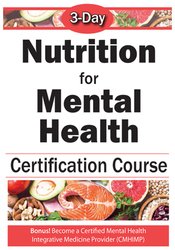
3-Day: Nutrition for Mental Health Comprehensive Course
- Speaker:
- Anne Procyk, ND
- Duration:
- 16 Hours 41 Minutes
- Language:
- Presented in EN, subtitles in EN and FR, handouts in EN and FR
- Format:
- Audio and Video
- Copyright:
-
Jun 19, 2019
- Product Code:
- POS054830
- Media Type:
- Digital Seminar

Description
Here’s what you’ll learn in this comprehensive training …
- Improve mood and behavior in clients using micro- and macronutrients
- Ideas for practical, affordable and individualized diets along with optimal cooking methods and recipes
- Safely and ethically apply integrated and nutritional medicine within your professional discipline’s scope of practice
- Improve assessment by learning to differentiate between a clinical presentation of mental illness vs. nutritional and/or hormonal imbalances
- Customize treatment plans through six unique nutrition methods for clients with mood lability
- Nourish both the brain and the gut, , the “second brain” through key nutrients
- Learn to identify gluten and casein sensitivity with the presentation of depression, psychosis and ASD in clients
- Implement evidence-based protocols for nutrition and herbal approaches for six DSM-5® categories
- Evaluate how client eating patterns may influence their mental health by using a food-mood assessment tool
- Increase compliance by using the DSM-5® Cultural Formulation tool to inform your treatment planning process
- Prevent side effects of polymedicine use through evaluation of drug-nutrient-herbal interactions
- Decrease dissociative symptoms in clients through stage-specific anaerobic and aerobic exercise and self-care methods
- Improve focus for clients with anxiety disorders with breathing techniques to reduce hyperventilation
- Adapt complementary and alternative methods for children and teens with behavioral and mental health disorders such as ADHD and ODD
- Learn when psychotropic medications, herbal medicines, and nutrients can be harmful to clients
- Improve anxiety and depression symptoms with essential fatty acids
- Discover how circadian rhythm contributes to depression, PTSD and bipolar disorder
- Evaluate the impact of blood sugar and genetic variations on mental health disorders and effective treatment
Credit
PESI, Inc. is approved by the Canadian Psychological Association to offer continuing education for psychologists. PESI, Inc. maintains responsibility for the program. This program is approved for 18.0 self-study continuing education hours. Full credit statement at: www.pesi.com/cpa-statement
NOTE: Tuition includes one free CE Certificate (participant will be able to print the certificate of completion after completing the on-line post-test (80% passing score) and completing the evaluation).
Continuing Education Information: Listed below are the continuing education credit(s) currently available for this non-interactive self-study package. Please note, your state licensing board dictates whether self-study is an acceptable form of continuing education, as well as which credit types are acceptable for continuing education hours. Please refer to your state rules and regulations. If your profession is not listed, please contact your licensing board to determine your continuing education requirements and check for reciprocal approval. For other credit inquiries not specified below, please contact cepesi@pesi.com or 800-844-8260 before the event.
Materials that are included in this course may include interventions and modalities that are beyond the authorized practice of your profession. As a licensed professional, you are responsible for reviewing the scope of practice, including activities that are defined in law as beyond the boundaries of practice in accordance with and in compliance with your profession's standards.
This self-study activity consists of 18.0 clock hours of continuing education instruction. Credit requirements and approvals vary per state board regulations. Please save the course outline, the certificate of completion you receive from the activity and contact your state board or organization to determine specific filing requirements.
The California Board of Behavioral Sciences accepts CE programs that are approved by other approval agencies, including several that approve PESI and its programs. A full list of approval agencies accepted by the BBS can be found at www.bbs.ca.gov/licensees/cont_ed.html under “Where to find CE Courses.” This intermediate level self-study activity consists of 18.0 clock hours of continuing education instruction.
PESI, Inc. is an approved provider with the Florida Board of Clinical Social Work, Marriage and Family Therapy and Mental Health Counseling. Provider Number 50-399. This self-study course qualifies for 18.0 continuing education credits.
The Montana Board of Behavioral Health no longer pre-approves any courses or sponsors. Each licensee is responsible for taking courses which contribute to their competence and directly relate to their scope of practice as defined in board statute (MAR 24-219-32). Licensees must keep CE documentation for three years in case of an audit. This intermediate level self-study activity consists of 18.0 clock hours of instruction.
The Pennsylvania State Board of Social Workers, Marriage and Family Therapists and Professional Counselors accepts many national association CE approvals, several of which PESI offers. For a full list, please see your State Board regulations at https://www.dos.pa.gov/ProfessionalLicensing/BoardsCommissions/. This intermediate level self-study activity consists of 18.0 clock hours of continuing education instruction.
This self-study program has been approved for 18.0 continuing education hours by the South Carolina Board of Examiners for Licensure of Professional Counselors, Marriage and Family Therapists, and Psycho-Educational Specialists. Provider #4540.
This self-study activity consists of 18.0 clock hours of continuing education instruction. Texas State Board of Examiners of Professional Counselors no longer approves programs or providers. PESI activities meet the continuing education requirements as listed in Title 22 Texas Administrative Code, Chapter 681, Subchapter J, Section 681.142 Acceptable Continuing Education. Please retain the certificate of completion that you receive and use as proof of completion when required.
This intermediate self-study activity consists of 18.0 clock hours of continuing education instruction. Credit requirements and approvals vary per state board regulations. Please save the course outline, the certificate of completion you receive from the activity and contact your state board or organization to determine specific filing requirements.
The California Board of Behavioral Sciences accepts CE programs that are approved by other approval agencies, including several that approve PESI and its programs. A full list of approval agencies accepted by the BBS can be found at www.bbs.ca.gov/licensees/cont_ed.html under “Where to find CE Courses.” This intermediate level self-study activity consists of 18.0 clock hours of continuing education instruction.
PESI, Inc. is an approved provider with the Colorado Chapter of the National Association of Social Workers. Provider #1413. This self-study course has been approved for 18.1 continuing education hours.
COLORADO PARTICIPANTS ONLY: If you did not answer YES to be reported to the Colorado Chapter of the NASW on the evaluation, please contact cepesi@pesi.com and provide the full title of the webcast, speaker name, date of live broadcast, your name and your license number in the email.
PESI, Inc. is an approved provider with the Florida Board of Clinical Social Work, Marriage and Family Therapy and Mental Health Counseling. Provider Number 50-399. This self-study course qualifies for 18.0 continuing education credits.
PESI, Inc. is an approved provider with the State of Illinois, Department of Financial and Professional Regulation, Division of Professional Regulation. License #: 159-000154. Successful completion of this self-study activity qualifies for 18.0 contact hours.
PESI, Inc. is an approved provider with the Kansas Behavioral Sciences Regulatory Board. Provider #14-006. This self-study course has been approved for 18.0 continuing education hours.
PESI, Inc. is an approved provider with the State of Minnesota, Board of Social Work. Provider #: CEP-140. This self-study package has been approved for 18.0 continuing education hours. This certificate has been issued upon successful completion of a post-test.
The Montana Board of Behavioral Health no longer pre-approves any courses or sponsors. Each licensee is responsible for taking courses which contribute to their competence and directly relate to their scope of practice as defined in board statute (MAR 24-219-32). Licensees must keep CE documentation for three years in case of an audit. This intermediate level self-study activity consists of 18.0 clock hours of instruction.
The Pennsylvania State Board of Social Workers, Marriage and Family Therapists and Professional Counselors accepts many national association CE approvals, several of which PESI offers. For a full list, please see your State Board regulations at https://www.dos.pa.gov/ProfessionalLicensing/BoardsCommissions. This intermediate level self-study activity consists of 18.0 clock hours of continuing education instruction.

PESI, Inc., is an approved provider with the Florida Board of Psychology.Provider Number #50-399.This product qualifies for 18.1 self-study continuing education credits.
This self-study activity consists of 18.0 clock hours of continuing education instruction. Credit requirements and approvals vary per state board regulations. Please save the course outline, the certificate of completion you receive from this self-study activity and contact your state board or organization to determine specific filing requirements.
PESI, Inc is an approved provider with the State of Illinois, Department of Professional Regulation. License #: 268.000102. Full attendance at this self-study course qualifies for 18.0 contact hours.
PESI, Inc. is approved by the Kentucky Board of Examiners of Psychology to offer continuing education for psychologists, approved provider #202411I. PESI maintains responsibility for this program and its content. This self-study activity will qualify for 18.0 contact hours.
PESI, Inc. is approved by the Pennsylvania State Board of Psychology to offer continuing education for psychologists. Provider #PSY000211. PESI maintains responsibility for the program(s). This self-study program qualifies for 18.0 continuing education hours.
This self-study activity consists of 18.0 clock hours of continuing education instruction. Credit requirements and approvals vary per state board regulations. Please save this course outline, the certificate of completion you receive from this self-study activity and contact your state board or organization to determine specific filing requirements.
The California Board of Behavioral Sciences accepts CE programs that are approved by other approval agencies, including several that approve PESI and its programs. A full list of approval agencies accepted by the BBS can be found at www.bbs.ca.gov/licensees/cont_ed.html under “Where to find CE Courses.” This intermediate level self-study activity consists of 18.0 clock hours of continuing education instruction.
PESI, Inc. is an approved provider with the Florida Board of Clinical Social Work, Marriage and Family Therapy and Mental Health Counseling. Provider Number 50-399. This self-study course qualifies for 18.0 continuing education credits.
PESI, Inc. has been approved as a provider of continuing education by the State of Illinois, Department of Professional Regulation. Provider #:168-000156. Full attendance at this self-study activity qualifies for 18.0 credits.
The Montana Board of Behavioral Health no longer pre-approves any courses or sponsors. Each licensee is responsible for taking courses which contribute to their competence and directly relate to their scope of practice as defined in board statute (MAR 24-219-32). Licensees must keep CE documentation for three years in case of an audit. This intermediate level self-study activity consists of 18.0 clock hours of instruction.
The Pennsylvania State Board of Social Workers, Marriage and Family Therapists and Professional Counselors accepts many national association CE approvals, several of which PESI offers. For a full list, please see your State Board regulations at https://www.dos.pa.gov/ProfessionalLicensing/BoardsCommissions/. This intermediate level self-study activity consists of 18.0 clock hours of continuing education instruction.
This self-study program has been approved for 18.0 continuing education hours by the South Carolina Board of Examiners for Licensure of Professional Counselors, Marriage and Family Therapists, and Psycho-Educational Specialists. Provider #4540.
This self-study activity consists of 18.0 clock hours of continuing education instruction. Texas State Board of Examiners of Marriage and Family Therapists no longer approves programs or providers. PESI activities meet the continuing education requirements as listed in Title 22 of the Texas Administrative Code, Chapter 801, Subchapter K, Section 801.264 Types of Acceptable Continuing Education. Please retain the certificate of completion that you receive and use as proof of completion when required.
PESI, Inc. is an approved provider by the CADTP, Provider #: 201. This Category H activity meets the qualifications for 18.0 CEUs (continuing education hours).
Provider #120924. This course has been approved as a CCB approved training and has been awarded 18.0 hours by the Connecticut Certification Board.

This self-study course has been approved by PESI, Inc., as a NAADAC Approved Education Provider, for 18.0 CE in the Counseling Services skill group(s). NAADAC Provider #77553. PESI, Inc. is responsible for all aspects of their programming. Full attendance is required; no partial credit will be awarded for partial attendance.
PESI, Inc. is a provider approved by the California Board of Registered Nursing, Provider #: 17118 for 18.0 self-study contact hours.
** You will need to provide your license number to PESI. PESI must have this number on file in order for your hours to be valid.
PESI, Inc. is an approved provider by the Florida Board of Nursing. Provider #: FBN2858. These materials qualify for 18.0 self-study contact hours.
PESI, Inc. is an approved provider by the Iowa Board of Nursing. Provider #: 346. Nurses successfully completing these self-study materials will earn 18.1 self-study contact hours. Please email cepesi@pesi.com with your license number, include the title, speaker name and date. PESI must have this number on file in order for your hours to be valid.
PESI, Inc. is an approved provider with the Florida Board of Occupational Therapy. Provider Number #50-399. This course qualifies for 18.0 self-study continuing education credits.
The California Board of Behavioral Sciences accepts CE programs that are approved by other approval agencies, including several that approve PESI and its programs. A full list of approval agencies accepted by the BBS can be found at www.bbs.ca.gov/licensees/cont_ed.html under “Where to find CE Courses.” This intermediate level self-study activity consists of 18.0 clock hours of continuing education instruction.
This self-study program has been approved for 18.0 continuing education hours by the South Carolina Board of Examiners for Licensure of Professional Counselors, Marriage and Family Therapists, and Psycho-Educational Specialists. Provider #4540.
This self-study activity qualifies for 18.0 continuing education clock hours as required by many national, state and local licensing boards and professional organizations. Save your activity advertisement and certificate of completion, and contact your own board or organization for specific requirements.
Handouts
| File type | File name | Number of pages | |
|---|---|---|---|
| Manual - 3-Day Nutrition for Mental Health Comprehensive Course (33.4 MB) | 57 Pages | Available after Purchase | |
| Manual - 3-Day Nutrition for Mental Health Comprehensive Course - French (33.4 MB) | 57 Pages | Available after Purchase | |
| Manual - 3-Day Nutrition for Mental Health Comprehensive Course - Italian (33.4 MB) | 57 Pages | Available after Purchase | |
| Manual - 3-Day Nutrition for Mental Health Comprehensive Course - German (33.4 MB) | 57 Pages | Available after Purchase | |
| Manual - 3-Day Nutrition for Mental Health Comprehensive Course - Spanish (33.4 MB) | 57 Pages | Available after Purchase |
Speaker
Anne Procyk, ND Related seminars and products
Anne Procyk, ND is a naturopathic physician practicing nutritional and integrative medicine to treat mental health disorders at Third Stone Integrative Health Center. She is on the forefront in understanding the complex relationships between physical and mental health. Dr. Procyk's thorough understanding of the latest research combined with her daily clinical experience give her the ability to translate voluminous and sometimes contradictory information into clear and effective strategies for real world patients.
She has given numerous lectures, has been featured in a number of books and made several television appearances. Dr. Procyk is a sought after leading expert on integrative strategies for dealing with depression, bipolar, and ADHD. She is also the author of Nutritional Treatments to Improve Mental Health Disorders: Non-Pharmaceutical Interventions for Depression, Anxiety, Bipolar & ADHD (PESI, 2018). She is a dynamic speaker who will inspire you to apply your new tools and transform your practice.
Dr. Procyk founded and currently sees patients at Third Stone Integrative Health Center in Essex, CT. She earned her doctorate at National College of Naturopathic medicine and graduated cum laude from Carleton College with degrees in chemistry and medical ethics. She is a member of the American Association of Naturopathic Physicians, the Connecticut Naturopathic Physicians Association, and the Association for the Advancement of Restorative Medicine.
Speaker Disclosures:
Financial: Dr. Anne Procyk is the founder and medical director of Third Stone Integrative Health Center. She receives a speaking honorarium, recording, and book royalties from PESI, Inc. She has no relevant financial relationships with ineligible organizations.
Non-financial: Dr. Anne Procyk is a member of the American Association of Naturopathic Physicians, the Connecticut Naturopathic Physicians Association, the Association for the Advancement of Restorative Medicine, and the Autism Families Connecticut.


Additional Info
Program Information
Access for Self-Study (Non-Interactive)Access never expires for this product.
Questions?
Visit our FAQ page at https://www.pesicanada.com/faq or contact us at https://www.pesicanada.com/contact-us
Objectives
- Evaluate the scientific research that links diet and nutrition to mental illness and its implications for treatment.
- Articulate how certain micronutrients and macro nutrients affect mood and behavior in clients.
- Evaluate the psychobiology and psychophysiology of mind and body interactions regarding six DSM® categories.
- Incorporate ethical and scope of practice considerations relative to integrated and nutritional medicine with respect to your own professional discipline.
- Communicate integrative and nutritional methods as they relate to client psycho-education.
- Discriminate between the clinical presentation of mental illness as compared to nutritional and/or hormonal imbalance.
- Recommend six nutritional methods for treating clients who present with mood lability.
- Correlate gluten and casein sensitivity with the presentation of depression, psychosis and ASD in clients.
- Demonstrate the use of a food mood assessment to evaluate client eating patterns and how those patterns may influence their mental health.
- Appraise the epidemiological research underlying the benefits of the Mediterranean diet and its specific application for client mental health.
- Interview clients using the DSM-5® Cultural Formulation tool to explore about health and healing in order to inform the treatment planning process.
- Evaluate drug-nutrient-herbal interactions for clients to prevent side effects of polymedicine use.
- Illustrate stage-specific anaerobic and aerobic exercise and self-care methods to decrease dissociative symptoms in clients.
- Integrate breathing techniques to reduce hyperventilation and improve focus among clients with anxiety disorders.
- Present adaptations of complementary and alternative methods for children and teens with behavioral and mental health disorders such as ADHD and ODD.
- Discuss contraindications of the use of psychotropic medications and herbal medicines and nutrients.
- Identify the evidence for the use of essential fatty acids for anxiety and depression.
- Evaluate the impact of blood sugar and genetic variations on mental health disorders and defective treatment.
Outline
The Complex Relationship Between Mental and Physical Health
How Foods Affect Moods
- Carbohydrates – A new way to think about cravings
- Effects protein may have on depression and anxiety
- Fats for mental health (depression, ADHD, bipolar)
- The connection between food, depression and anxiety
- Vitamins: B-Vitamins, 5-MTHF, Vitamin D
- Minerals: Magnesium, calcium
- Food as “brain-mind-medicine”
- Fats: Essential fatty acids, toxic fats, fish oil
- Protein: the building blocks of happiness
- Nutrients to improve mental health and cognitive function
- Vitamins, minerals, glandulars, and special nutrients for the non-nutritionist
- Regulate hormonal imbalance
- Balance blood sugar to balance mood
- Cultural and genetic variations
- Enhance digestion for mental health
- Thyroid function and mental health
- Seven major herbs for PTSD, anxiety, depression, sleep, and cognitive health
- Endocannabinoid deficit theory
- Cannabis and psychedelic medicine
- THC versus CBD
- Evidence for medical cannabis for mental health PTSD and chronic pain
- Adaptogens: Ginseng, licorice, ashwaganda
- Melatonin
- Smell, mood, and cognition
- Evidence for essential oils to alter mood and cognition
- Interactions with pharmaceuticals
- Transcending mind-body separation: Understanding the complex relationships
- The factors that cause “chemical imbalance”
- Beyond pharmaceutical management
- Balancing circadian rhythm
- Apply breathing exercises for mental health
- Enhance sleep and address insomnia
Assessments and Evidence-Based Research
Assessments Using Integrative Approaches
- Conduct a basic nutritional food/mood assessment
- Conduct an adrenal stress and biological rhythm assessment
- Culture and ethnicity assessment and treatment
- The Cultural Formulation Interview and CAM methods
- Basic lab tests for optimal mental health
- Anxiety and PTSD
- Depression
- ADHD
- Fatigue
- Anger
- Bipolar disorder
- Lack of mental clarity
- Other mental health concerns
- Hormonal imbalance
- Anxiety vs. hypoglycemia
- Inflammation
- Digestion
- Depressed, fatigued or malnourished?
- Side effects of medications
- Strategies to reduce inflammation: The major factor in depression, anxiety, bipolar, and ADHD
- Chronic illness, fibromyalgia
- Anxiety and digestion
- The Second brain: Microbiome, probiotics and GABA, and anxiety
- Sleep, adrenal health, and rhythms
- Anger, alcohol abuse and liver health
- Genetics, depression and brain
- PTSD and auto immune, addictions and cognition
- ADHD, ASD, and food sensitivities
- Integrative approach recovery from addictions
Clinical Applications – Non-Pharmaceutical Treatment Strategies
Holistic Treatment Interventions
- Address clients concerns and provide alternatives to psychotropics
- Herbal medicine for mental health
- Strategies for clients who want to stop their medications
- Ayurvedic medicine and mental health
- Exercise: Elevate serotonin and regulate stress hormones
- Sound and music for insomnia, anxiety and anger
- Toning, binaural music
- Depression & Seasonal Affect Disorder
- Anxiety, PTSD, and complex trauma
- Bipolar
- ADHD
- Body dysmorphia
- OCD
- Bulimia
- Insomnia
- Addictions
- Obesity
- Psychosomatic symptoms
- Pre-menstrual syndrome and menopausal symptoms
- Food: The Good, the Bad, and the Fake
- Sleep: The 4 habits critical to refreshing sleep
- Exercise: Elevate serotonin and regulate stress hormones
- Stress: A Holistic Approach
- Feed your brain
- The spectrum of somatic and bodywork therapies
- Acupuncture
- The NADA protocol for addictions
- Cranial electrical stimulation for PTSD, insomnia, and optimal cognition
- When to refer
- Children: Supporting sleep, focus, mood and attention
- Alternatives to psychotropics for ADHD
- Middle life: Peri-menopause, menopause, andropause
- Preventing cognitive decline
- Nutrition and integrative methods to support people with dementia and their caregivers
- Ethics, law and competency
- Nutritional therapies
- Culinary medicine
- Behavioral medicine
- Nutritional supplementation
- Herbal medicine
- Hydrotherapies for mood management
- Bodywork therapies
- Acupuncture and cranial electrical stimulation
- Sound and music for insomnia and mood
- Stage appropriate yoga for anxiety, pain and PTSD
- Integrative detoxification for addiction
- When and where to refer clients
- How to find the right provider
- Questions to ask before referring
- Develop a niche practice as a certified specialist
- Professional organizations and more training
- Controversies and hot topics
Target Audience
- Counselors
- Case Managers
- Psychotherapists
- Social Workers
- Dieticians
- Marriage & Family Therapists
- Psychologists
- Addiction Counselors
- Therapists
- Nurses
- Other Mental Health Professionals
- Occupational Therapists
Reviews
Satisfaction Guarantee
Your satisfaction is our goal and our guarantee. Concerns should be addressed to info@pesicanada.com.
Please wait ...